Brandi Digital Skills
The Challenge
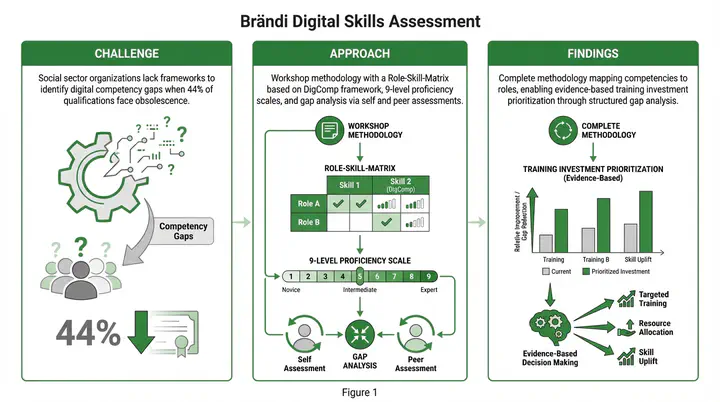
The World Economic Forum projected that 44% of professional qualifications would be outdated by 2027, yet organizations in the social sector faced particular difficulties in identifying skill gaps and designing effective upskilling strategies. Stiftung Brandi, a Swiss social and professional foundation based in Kriens, needed to understand which digital competencies its employees required, where gaps existed relative to current skill levels, and which training offerings could close those gaps. No systematic framework for digital competence assessment and development existed for their workforce.
Approach and Methods
The project was structured into three sub-projects spanning 2023 to 2024. The first phase developed workshop concepts for deriving future skill requirements by analyzing technology trends for each business area and assessing skill needs with experienced employees, building on previously conducted DigiComp self-assessments. The second phase created a scientifically grounded Skill Matrix based on the European Digital Competence Framework (DigiComp), using a 9-level proficiency scale from Beginner (B1-B3) through Intermediate (I1-I3) to Expert (E1-E3). Self-assessment and peer-assessment methods mapped current competency levels against target profiles for each organizational role. The third phase identified internal and external training opportunities for each competency area, conducted a market analysis of education providers, and developed personalized continuing education recommendations.
Key Findings
The project delivered a complete workshop methodology and training materials, a Role-Skill-Matrix mapping digital competencies to organizational roles, and a structured continuing education catalog matching training offerings to individual skill profiles. The gap analysis revealed concrete discrepancies between current and target skill levels across the organization, enabling Stiftung Brandi to prioritize its training investments based on evidence rather than assumptions.
Implications
The methodology was designed to be transferable, providing a blueprint that other organizations in the social sector can adapt for their own digital competence development. The project demonstrated that even in sectors where digital transformation is not the core business, a systematic approach to skill profiling and gap analysis can make upskilling efforts more targeted and cost-effective. The combination of self-assessment with peer-assessment provided more reliable competence estimates than either method alone.
Team and Funding
The project was led by Prof. Dr. Roman Rietsche (BFH, Institute for Digital Technology Management) in collaboration with Eva Ritz and Leonie Freise (University of St. Gallen). Stiftung Brandi, led by Prof. Dr. Andreas Liedtke, served as the practice partner and funded the project (2023 to 2024).

Roman Rietsche
Research Professor for Information Systems and AI
My research interests include AI in Education, Human-centered Re- and Upskilling Digital Interventions.