Information Sharing in the Metaverse
The Challenge
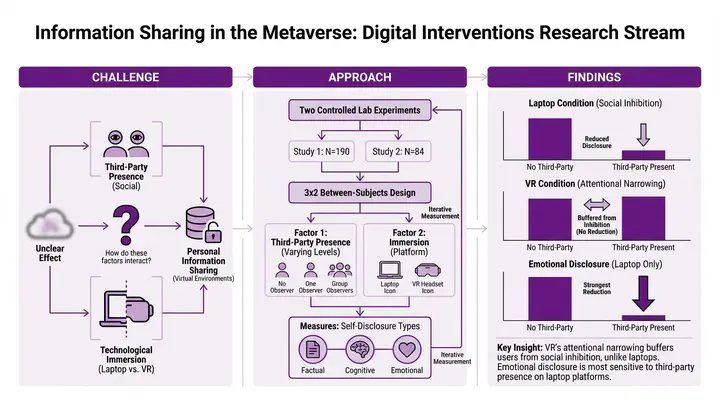
As metaverse platforms gain traction for education, commerce, and social interaction, a critical question emerged: how do users decide what personal information to share in virtual environments, and how does the presence of other avatars affect that behavior? In physical settings, people disclose less when others are watching. Whether this social inhibition transfers to virtual spaces, and whether the level of technological immersion moderates the effect, had not been systematically studied.
Approach and Methods
Drawing on Social Penetration Theory, which conceptualizes self-disclosure as layered from factual to cognitive to emotional information, two controlled lab experiments were designed. Participants engaged in information exchange tasks under varying conditions: different levels of immersion (laptop-based 2D access versus VR headset-based 3D access) and different levels of bystander certainty (absent, uncertain presence, or certainly present). The experiments used pre-test and post-test designs with approximately 30 participants per condition. A second study replicated the design in a commercial insurance context to test generalizability.
Key Findings
The results revealed an asymmetry between immersion levels. In the laptop condition (low immersion), bystanders significantly reduced self-disclosure across all conditions, with emotional self-disclosure showing the steepest decline, consistent with Social Penetration Theory’s “onion model.” However, in the VR condition (high immersion), bystander presence had no significant effect. Participants’ willingness to share factual, cognitive, or emotional information remained consistent regardless of whether bystander avatars were visibly present. The second study in a commercial context confirmed these findings. The proposed explanation was that immersive VR environments induce a form of attentional narrowing, where the headset creates a psychological barrier that makes users less sensitive to social context.
Implications
For privacy-sensitive applications such as healthcare consultations, counseling, or financial services conducted in virtual spaces, the choice of immersion level materially affected how much users were willing to disclose. VR environments may inadvertently encourage over-sharing by reducing users’ awareness of social context, while less immersive interfaces may suppress disclosure in ways that limit the effectiveness of collaborative or therapeutic interactions. Platform designers need to consider these asymmetric effects when choosing interaction modalities for sensitive applications.
Team and Funding
The project was conducted at the Bern University of Applied Sciences (BFH), Institute for Digital Technology Management, led by Prof. Dr. Roman Rietsche. The research was part of the HDT research program at BFH.

Roman Rietsche
Research Professor for Information Systems and AI
My research interests include AI in Education, Human-centered Re- and Upskilling Digital Interventions.