Reflective Writing for Personal Development: Leveraging AI for Scalable Learning
The Challenge
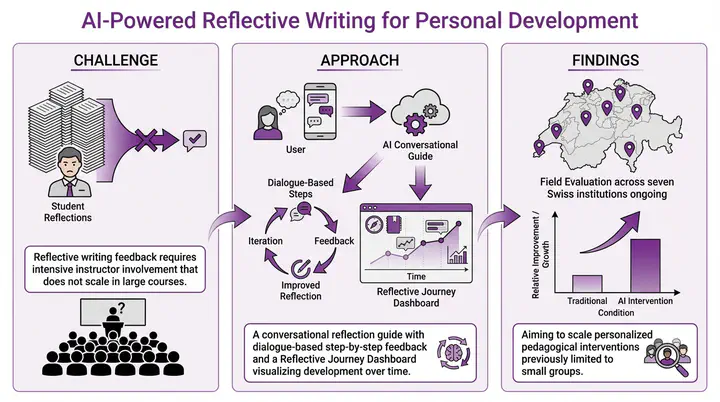
Reflective writing is a key pedagogical method for developing metacognition, self-awareness, and competencies required for addressing global challenges such as the United Nations’ Sustainable Development Goals. The World Economic Forum estimated that 71% of workers will need significant re- or upskilling, and reflective practice supports this transition. However, universities face substantial implementation barriers: providing tailored, personalized feedback on reflective writing requires intensive instructor involvement that does not scale beyond small seminar formats. As a result, students in large courses lack the guided feedback that is essential for developing reflective writing skills.
Approach and Methods
The project develops two complementary AI-powered innovations integrated into the product of the implementation partner Rflect AG. The first is a conversational reflection guide that provides step-by-step, dialog-based feedback on students’ reflective writing. The guide incorporates cognitive and motivational parameters from each learner to provide dynamically tailored support, using techniques such as chain-of-thought prompting, chain-of-abstraction, and self-reflection. The second innovation is a Reflective Journey Dashboard that visualizes each student’s reflection development over time, while giving educators aggregated views of competence development across an entire class. Both innovations are being tested with implementation partners across seven Swiss higher education institutions including ZHDK, ZHAW, FHNW, HWZ, and ETH.
Key Findings
The project is ongoing. Results from the field evaluations across partner institutions are expected by mid-2026.
Implications
The project addresses a fundamental tension in higher education: the pedagogical value of reflective writing is well established, but its implementation at scale remains impractical without technological support. By combining AI-driven conversational guidance with learning analytics dashboards, the project aims to create a model for scaling personalized pedagogical interventions that were previously limited to small-group settings. The approach is designed to be transferable to any educational context where structured reflection is used for competence development.
Team and Funding
The project is led by Prof. Dr. Roman Rietsche (BFH, Institute for Digital Technology Management) with Thiemo Wambsganss (BFH) and Anna Jasinenko (University of St. Gallen) as research partners. Rflect AG serves as the primary implementation partner. The project is funded by Innosuisse (project number 114.545 IP-ICT, August 2024 to May 2026).

Roman Rietsche
Research Professor for Information Systems and AI
My research interests include AI in Education, Human-centered Re- and Upskilling Digital Interventions.